The Existential Matrix: A Differentiated Framework for Situated Human Participation
About 30 min read
Submission Draft 1.0
Author: Stuart Hollinger
Journal-neutral theoretical manuscript
In this manuscript
- 1. Introduction
- 2. Scope and Methodological Discipline
- 3. Situated Participation and Participant Configuration
- 4. Subject-Relative Availability and Conditional Representation
- 5. Possibility, Orientation, and Action
- 6. Temporal Recursion, Positing, and Sedimentation
- 7. Derived Diagnostic Model: Disagreement Shape
- 8. Empirical Programme and Failure Conditions
- 9. Discussion
- 10. Conclusion
- References
Abstract
The Existential Matrix is proposed as a differentiated framework for finite situated human participation. It does not propose a new generic agent-environment loop: partially observable decision models, ecological and enactive approaches, control theories, and dynamical frameworks already provide sophisticated accounts of partial environmental access, perception-action coupling, internal state, action, and temporal feedback. The Matrix instead organizes several human-level distinctions within a common participation architecture and treats their status as defeasible. A participant is indexed locally within a contextually scoped System and characterized by a time-varying configuration. The current framework proposes sensorimotor/environmental, embodied, cognitive-mnemonic, and higher-order orientational functions as a candidate four-coordinate decomposition of that configuration. Systemic structure is distinguished from participant-relative manifestation, while representation is introduced when representational uptake is relevant rather than assumed to mediate every form of participation. Present participation is recursively related to later participant and System conditions through multiple persistence mechanisms. The framework's methodological principle is minimum sufficient distinction: distinctions should be retained where their collapse loses consequential predictive, diagnostic, intervention, conceptual, or normative information, and simplified where they do not. Candidate empirical programmes include manifestation-representation dissociation, governing-relation models of higher-order orientation, real versus represented Action Horizons, manifestation trajectories, and structure-matched interventions for disagreement. The Matrix is therefore offered as a corrigible theoretical architecture rather than a validated mechanism of cognition. Its central philosophical claim is that reality exceeds finite representation without eliminating finite participation in reality.
Keywords: situated participation; embodiment; representation; affordances; orientation; disagreement; systems; theoretical integration
1. Introduction
Human participation is simultaneously local, embodied, environmental, historical, and selective. A person acts from a particular place and time, under bodily and cognitive conditions not wholly chosen in the present, within environments already structured by physical constraints, other persons, artifacts, institutions, language, and prior activity. Only some portion of that structure becomes presently available, and the participant may respond directly through skilled perception-action coupling, form representations of what is encountered, deliberate among possibilities, or combine these processes in different proportions.
No general theory is required to establish that organisms interact recursively with environments. Partially observable decision models distinguish environmental states from observations and internal belief states while modeling action and environmental transition (Kaelbling, Littman, & Cassandra, 1998). Active-inference architectures integrate hidden states, observations, beliefs, preferences, policies, and action within temporally extended generative models (Da Costa et al., 2020). Ecological psychology emphasizes organism-environment relations, affordances, and perception-action coupling rather than an isolated internal agent (Gibson, 1979; Lobo, Heras-Escribano, & Travieso, 2018). Perceptual Control Theory provides a hierarchical feedback architecture in which actions counter disturbances in order to maintain controlled perceptual variables near reference states (Parker et al., 2020). The broader 4E literature is itself heterogeneous rather than a single unified doctrine (Alexander, 2025).
The Existential Matrix therefore does not claim novelty for the abstract sequence environment -> agent -> action -> environment. At sufficient abstraction, that structure is generic. The problem addressed here is narrower: human-level explanation often collapses distinctions that may matter for diagnosis and intervention. Two people may belong to the same information System without receiving equivalent manifestations of it. Two people may receive similar manifestations while constructing different representations. A person may correctly represent available actions while lacking the structural capacity to perform them, or may possess genuine options they do not represent as available. A measurable transition boundary may differ from the boundary a person uses for decision and from the boundary defended normatively.
The Matrix treats these as candidate consequential distinctions rather than assuming in advance that they can safely be merged. Its organizing strategy is one of differentiated integration: related constructs are modeled together without being treated as interchangeable merely because they interact. The corresponding methodological principle is minimum sufficient distinction: preserve a distinction where collapsing it loses consequential conceptual, predictive, diagnostic, intervention, or normative information; collapse or demote it where the distinction fails to earn its complexity.
This principle does not entail metaphysical anti-reductionism. A conceptual distinction does not automatically imply empirical non-redundancy, still less ontological independence. A major purpose of the empirical programme is precisely to determine which proposed distinctions survive stronger tests. The framework's contribution is therefore architectural and methodological before it is mechanistic. Existing theories may supply domain mechanisms; the Matrix provides a common vocabulary for deciding which human-level distinctions must remain available when those mechanisms are applied.
Three architectures organize the framework. Configuration concerns the presently operative condition of the participant. Access concerns what becomes available to that participant from the surrounding System. Recursion concerns how present participation inherits prior conditions and can contribute to later ones. In compact form: situated participation = configuration + access + recursion. The scientific burden is not whether these three words can redescribe human activity, but whether the distinctions nested within them improve prediction, diagnosis, intervention, compression, or transfer relative to simpler alternatives.
2. Scope and Methodological Discipline
The Matrix operates across several levels of discourse, and much of its historical richness comes from moving among them. That movement also creates a major risk: support at one level can be mistaken for proof at another. The mature framework therefore distinguishes genealogical, architectural, empirical, and metaphysical/theological status. Genealogical status concerns what authentically belongs to the historical project. Architectural status concerns which distinctions currently improve the formal framework. Empirical status concerns which distinctions survive measurement and comparison with alternatives. Metaphysical or theological status concerns what is ultimately claimed about reality, normativity, God, Nothingness, or other ontological questions.
These relations are not entailments. Genealogy does not imply architectural necessity; architecture does not imply empirical success; empirical success does not imply metaphysical truth. A historically important concept may turn out to be empirically redundant. A modern construct absent from the early genealogy may turn out to be scientifically useful. An empirically useful proxy does not establish the existence of its strongest metaphysical interpretation.
The same discipline applies to the meaning of non-identity. For any proposed distinction X != Y, three claims should be separated. Conceptual non-identity means that X and Y perform distinguishable explanatory roles. Empirical non-redundancy means that separately measuring X and Y adds consequential information. Ontological non-identity means that X and Y correspond to genuinely distinct features of reality. The first does not entail the second, and the second does not entail the third. For example, cognitive-mnemonic processing and higher-order orientation may be conceptually distinguishable even if future empirical work shows that a separate orientational coordinate adds little beyond richer cognitive models.
The framework also retains a strict proxy-referent firewall. Evidence that a psychological receptivity construct predicts creative performance does not establish literal Nothingness. Evidence that higher-order orientation predicts action does not establish God. Evidence that people organize judgments around dimensions does not establish mind-independent Forms. Likewise, the generative power of a theory does not establish its truth. A concept may be fruitful, beautiful, or highly generative while remaining false or incomplete.
The Matrix applies these constraints to itself. It is a representation of finite participation, not reality itself. The model must remain corrigible, and its historical vocabulary receives no exemption from empirical revision. This reflexive model non-identity is not an ornamental philosophical statement; it is a rule against converting the framework's own categories into self-certifying ontology.
3. Situated Participation and Participant Configuration
The operative starting point is participant i at time t within a contextually scoped System, written schematically as i@t | Sigma_t^(c). The notation indexes a participant from a local temporal standpoint without requiring the empirical framework to treat Subject or Moment as independent mechanisms. The project terms Subject and Moment remain philosophically useful because they foreground perspective and lived locality; empirically, they can be translated as participant i during a local measurement window.
The participant's local Moment is not the total world state. Events may be real without presently becoming available to participant i. Likewise, the System must be scoped. A workplace conflict might require a team-level System for one question and an organization-level System for another. 'System' should not become a universal remainder containing everything unexplained. It denotes the structured context relevant to a specified analysis.
The embodied participant belongs to that System. The framework does not place a disembodied observer outside reality. The Subject index identifies the standpoint from which participation is locally organized; it does not imply spatial separation from the physical or social world. This preserves first-person locality without making the framework subjectivist.
The Matrix further requires a representation of presently operative participant configuration, C_i(t). This is not assumed to be a fixed trait vector. It may include fast-changing states, medium-timescale goals or moods, and slow-changing habits, bodily adaptations, memory structures, or commitments. The broad idea is that the same or similar manifestation can matter differently across participants or Moments because participant configuration differs.
The current framework proposes four functional coordinates as a candidate decomposition of configuration: A^S, a sensorimotor/environmental interface; A^B, embodied physiological condition; A^R, cognitive-mnemonic processing; and A^G, a higher-order orientational function. Historically these are the Four Affections. They are treated as functional coordinates rather than anatomically independent modules or four substances composing a person.
A^S characterizes the participant's mode and capacity of environmental exchange. It should not be reduced to passive sensory input; ecological approaches emphasize reciprocal perception-action coupling and organism-relative affordances (Gibson, 1979; Lobo et al., 2018). A^B represents organismic condition relevant to present capacities and experience. Contemporary interoception research supports distinguishing bodily signals and their sensing from higher-order interpretation and external context, while also emphasizing their interaction in emotional processing (Greenwood & Garfinkel, 2025).
A^R denotes cognitive-mnemonic processing broadly construed. It includes active thought and latent memory structures relevant to participation and is intentionally broader than scientific working memory. It does not imply that all skilled participation must pass through an explicit propositional representation. A^G denotes the proposed function through which competing commitments or possibilities acquire relations of priority or governance. Existing research on values, global meaning, self-concordant goals, and hierarchical goal conflict already provides strong neighboring constructs (Park, 2010; Sagiv & Schwartz, 2022; Sheldon & Elliot, 1999; Kelly, Mansell, & Wood, 2015). Accordingly, the Matrix does not claim to discover values or goal hierarchy. Its narrower question is whether modeling relations among governing commitments adds predictive value under conflict.
The Four-Affection proposal is therefore a model-comparison hypothesis rather than an axiom. SBRG should compete with simpler models such as SBR and richer models that add Emotion, Sociality, or empirically learned dimensions. The exact number four receives no empirical immunity from genealogy. The hypothesis survives only if the decomposition provides useful coverage or prediction without semantic stretching or unnecessary complexity.
4. Subject-Relative Availability and Conditional Representation
A central distinction in the Matrix is between what belongs to a relevant System and what actually becomes available to a particular participant. Let X_k denote some Systemic structure. Its presence in the System does not imply equivalent availability across participants. Instead, X_k -> m_(k->i), where m_(k->i) denotes the participant-relative manifestation through which X_k becomes available to participant i.
This distinction has strong formal precedent. Partially observable decision models distinguish environmental state from agent observation (Kaelbling et al., 1998). The Matrix extends an analogous distinction into human domains where manifestation may consist of a spoken explanation, social interaction, institutional consequence, digital feed, camera angle, particular message, or other situated form of availability. The scientific claim is not that the Matrix discovered partial observability. It is that explicit measurement of participant-relative manifestation can prevent access differences from being misdiagnosed as differences in interpretation or character.
Manifestation is relational. What becomes available can depend upon location, timing, language, visibility, attention, bodily capacity, social role, permission, technological filtering, and surrounding structure. Two participants can therefore inhabit the same broad System while receiving materially different manifestations of it. Shared System membership is not shared access.
The historical project term Expose is retained for a narrower class of Systemic structures whose being posit matters. An Expose is a structure whose being instantiated, expressed, externalized, or stabilized changes its persistence, accessibility, or relational reach. A private intention can become a written agreement; an unspoken thought can become a public statement; an informal routine can become an institutional rule. The significance lies in the transition from private or transient organization to Systemically posit structure. Expose is therefore a typed Systemic construct rather than a synonym for any object whatsoever.
Representation is conditional rather than universal. The Matrix previously risked implying a mandatory sequence X -> manifestation -> representation -> action. A representation-neutral formulation allows at least two broad routes: direct or minimally representational coupling, m -> action, and representationally mediated participation, m -> X-hat -> action. These routes are not mutually exclusive. Ecological psychology's non-representational emphasis makes this neutrality theoretically important (Lobo et al., 2018). The framework can accommodate explicit representation where belief, memory, interpretation, reasoning, or disagreement is at issue without forcing a representational bottleneck into every skilled action.
Where representation is analytically relevant, the Matrix preserves the non-identity of target, manifestation, and representation. X_k is not identical to m_(k->i), and X-hat_(k|i) is not identical to either. This is a conceptual distinction, not automatically a claim about separate biological modules. The representation may nevertheless track its target accurately. Representation gap is therefore not representation failure. The distinction permits both error and successful tracking.
The same architecture applies interpersonally. Another person becomes available through expressions, actions, testimony, and shared situations, and a participant may form a representation of that person. The Other should not be identified with the representation of the Other. Existing empathic-accuracy research already shows that affective empathy and accuracy are not interchangeable (Zaki, Bolger, & Ochsner, 2008). The Matrix uses this broader non-identity to keep resonance, felt understanding, actual understanding, and accuracy analytically separable.
Availability is also historical. The participant's current exposure ecology should be distinguished from the sequence of manifestations actually encountered. Define M_i[t0:t1] as the ordered manifestation trajectory relevant to the analysis. Broader exposure and niche-construction literatures already show that histories and environments matter across time (Nagatsu, Kaaronen, Salmela, & MacLeod, 2023). The Matrix-specific hypothesis is narrower: when order, timing, omission, or contextual presentation matter, participant-relative manifestation history may predict later representation or action better than coarse System membership or current exposure summaries.
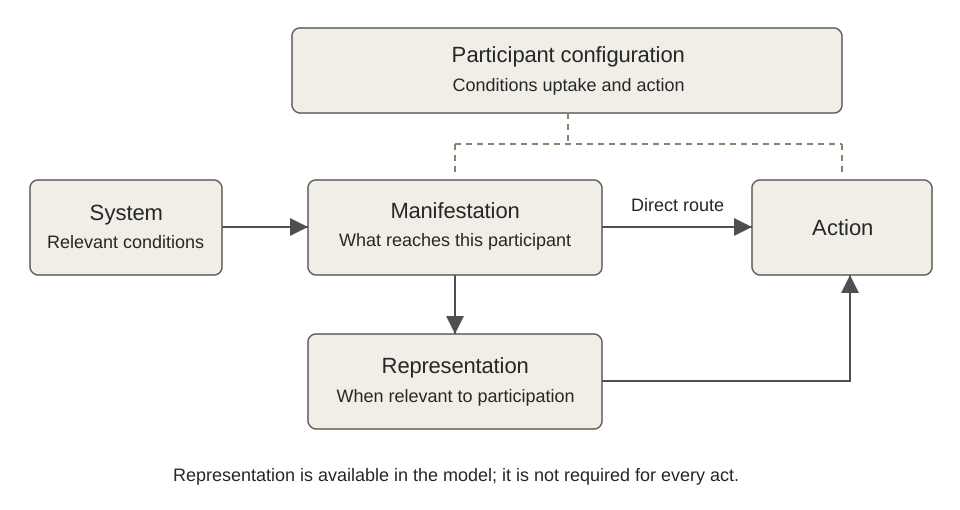
Figure 1. Representation-neutral participation architecture. Participant-relative manifestation can contribute directly to action or, where relevant, to representation before action; participant configuration conditions these relations. Diagram redrawn from the manuscript’s stated architecture.
5. Possibility, Orientation, and Action
Manifestation and representation do not by themselves determine participation. A participant acts within a field of possibilities, constraints, capacities, and priorities. The Matrix therefore distinguishes what is actually possible from what is represented as possible and, in reflective conflict, from what is treated as worth doing.
Let H_i^real(t) denote the set or structure of actions genuinely feasible for participant i under the relevant conditions. It depends upon System structure, participant capacities, resources, and constraints. The concept has clear neighbors in affordance theory, where possibilities for action are relationally defined with respect to organism and environment (Gibson, 1979). The Matrix's distinctive use is diagnostic: it keeps actual possibility separate from represented possibility.
Let H-hat_i(t) denote the participant's represented Action Horizon. In general H-hat_i need not equal H_i^real. A feasible option may be unrepresented; an represented option may be infeasible. This yields a practically important distinction between structural constraint and representational constraint. A person who lacks a real option requires a different intervention from a person who possesses that option but does not represent it as available.
Where multiple possibilities compete, the current configuration hypothesis introduces higher-order orientation. The historical term God Place is retained as genealogy; the academic construct is higher-order orientational function. Its role is not to duplicate ordinary desire or goal pursuit. Desire and orientation can diverge: a participant may strongly want an outcome while endorsing against it. The orientational construct is intended to model governance among competing commitments rather than motivational intensity alone.
A derived orientational model, historically called God Shape, can be represented as G_i^(c) = (V_i, R_i^(G,c)), where V_i contains relevant commitments and R_i^(G,c) contains context-sensitive relations of priority, compatibility, conflict, or governance. Existing values research describes structured relations of conflict and compatibility, self-concordance research links goals to core values, and hierarchical models of goal conflict already organize goals vertically (Sagiv & Schwartz, 2022; Sheldon & Elliot, 1999; Kelly et al., 2015). The Matrix hypothesis is therefore not the existence of hierarchy itself. The stronger test is whether an idiographic governing-relation graph improves prediction of action under cross-value conflict beyond flat or standard hierarchical alternatives.
Orientation is descriptive, not self-validating normativity. A coherent orientational architecture can be mistaken or destructive. Orientation therefore does not equal objective goodness. This firewall matters because the broader project contains normative and theological extensions, but the empirical framework must be capable of describing high-order governance without assuming that whatever governs should govern.
Will is treated as derived rather than primitive. A resultant directional tendency can arise from participant configuration, represented or directly available possibilities, and System conditions, but intention is not action. The difference between endorsed action and performed action can be represented by an Orientation-Action Gap. A large gap may reflect bodily limitation, habit, coercion, misrepresentation of options, structural constraint, or competing motivation. The construct is diagnostic rather than automatically moral.
Power is also derived from recursion rather than added as a primitive. Participants differ in their capacity to alter later System conditions. A participant may have clear representation and strong orientation while possessing little Systemic leverage. Conversely, institutional power can turn a local representation into a durable Expose that later manifests to many others. This asymmetric recursive influence helps the Matrix represent agency without romanticizing sovereignty.
6. Temporal Recursion, Positing, and Sedimentation
The Matrix is not a sequence of isolated snapshots. Present participation occurs under conditions inherited from prior states, and present activity can enter the conditions encountered later. The general sequence is inherit -> encounter -> participate -> inherit anew. In reflectively mediated participation, encounter may additionally lead to representation and orientation before action.
The project term sedimentation denotes persistence across this recursion. It is not a substance. An earlier event is sedimented when it remains consequential for a later participant or System state through some identifiable mechanism. Memory, habit, physiological adaptation, artifacts, relationship history, and institutional rules can all instantiate persistence, but they do not become one universal Sedimentation variable by virtue of doing so.
Past event and present trace should remain distinct. A past occurrence is not identical to a present memory of that occurrence or to a current institutional consequence. This distinction permits memory revision, reinterpretation, forgiveness, or identity change without implying that history itself has been rewritten.
Participant and System transitions can be represented schematically as coupled dynamics. C_i(t+1) depends partly on prior configuration, manifestation, representation where relevant, action, and System conditions. Sigma_(t+1) depends partly on prior System state, the actions of multiple participants, and non-agentic influences. The coupling is often asymmetric: an institution may alter a participant much more strongly than one participant alters the institution. This asymmetry is important for representing power and structural constraint.
Positing is a particularly important temporal mechanism. Local participation can produce a structure that persists beyond the originating Moment. A message, rule, artifact, contract, publication, or built environment may continue to manifest to people who were absent when it was created. Systems can therefore amplify finite Moments across time and subjects: local action -> persistent Expose -> future manifestations.
This recursive view has substantial neighboring precedent. Behaviour-setting theory foregrounds the predictive importance of structured settings (Avram et al., 2024), and cultural niche-construction work explicitly treats human cognitive and affective goals as achieved through engagement with environments that humans also transform (Nagatsu et al., 2023). The Matrix does not claim discovery of environmental feedback. Its additional vocabulary is meant to preserve participant-relative manifestation, posit structure, and participant configuration within the same temporal architecture.
Formation should remain descriptive rather than normatively loaded. Repeated participation can produce skill, discipline, care, rigidity, aggression, or avoidance. The fact that a pattern has sedimented does not show that it is good. Normative evaluation requires an additional standard.
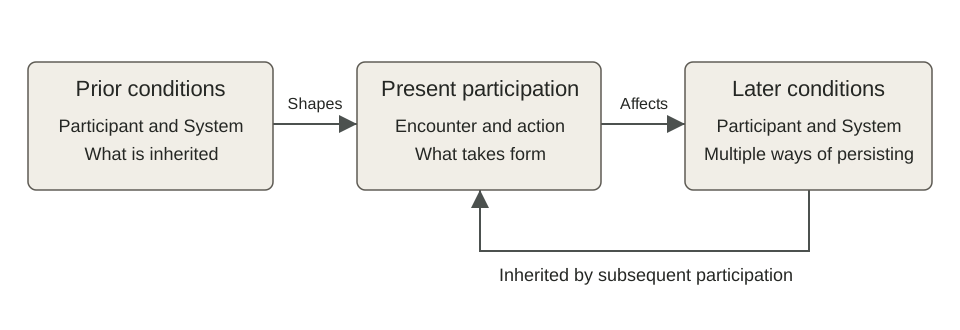
Figure 2. Recursive participation across time. Present participation inherits prior participant and System conditions and can contribute to later conditions through multiple persistence mechanisms. Diagram redrawn from the manuscript’s stated architecture.
7. Derived Diagnostic Model: Disagreement Shape
The strongest current empirical application of the Matrix is a domain-specific diagnostic model of disagreement. The ordinary statement that two people disagree can collapse several structurally different divergences. The Disagreement Shape model asks where the divergence primarily resides and whether that localization predicts which intervention will help.
The current structured profile includes seven possible sites: manifestation/access (m), factual representation (E-hat), epistemic-adjudicative standards (K), framing or problem representation (Phi), placement on an ordered dimension (q), criterion or threshold (F), and higher-order orientation (G). Not every component is defined in every disagreement. In particular, q and F apply only where an ordered frame is relevant. Disagreement Shape is therefore a structured profile rather than a fixed Euclidean vector.
Manifestational divergence occurs when participants did not receive equivalent access to the relevant material. The candidate intervention is to equalize or clarify access. Representational divergence occurs when participants received similar manifestations but represent the relevant state differently; candidate interventions include evidence review, factual correction, or inference clarification. Epistemic-adjudicative divergence concerns different standards for what counts as adequate evidence, source quality, inference, or burden of proof. Framing divergence concerns different problem representations or organizing frames.
Placement divergence and threshold divergence should remain separate. Two people may use the same risk scale but estimate the case differently, or may agree on the estimate while choosing different action thresholds. The Matrix further distinguishes functional, decisional, and normative thresholds. A measurable transition in outcomes does not by itself determine a person's decision criterion or the normatively defended boundary. Geometry alone cannot derive ought.
Orientational divergence occurs when participants share much of the descriptive architecture but differ in what they treat as governing. More factual information may not resolve such a conflict because the remaining disagreement concerns priorities or trade-offs rather than evidence. This does not imply that value dialogue automatically produces agreement. A structurally successful conversation may end with disagreement that is better localized and more mutually understood.
The central empirical prediction is a Level-Matched Intervention Principle: an intervention directed at the primary site of divergence should generally outperform an intervention directed at a weakly coupled non-target site, all else equal. The claim is probabilistic rather than absolute because levels interact. A value intervention can sometimes alter framing; a framing intervention can alter factual interpretation. The relevant prediction is therefore an interaction between disagreement structure and intervention type, moderated by coupling pathways.
Outcomes must also remain differentiated. Agreement, factual accuracy, actual understanding, felt understanding, respect, and compromise are not equivalent. A matched intervention may increase understanding without increasing agreement. The empirical programme should therefore use multidimensional outcomes rather than treating consensus as the only success criterion.
A first validation study can use controlled vignettes in which disagreements are generated primarily at one site and ask blinded raters to classify the source. A second study can test judgments about matched versus mismatched interventions. A stronger experiment can then manipulate disagreement structure and intervention type in real interactions and estimate the Disagreement Shape x Intervention interaction. The Matrix earns scientific value only if the richer profile predicts outcomes better than simpler classifications such as overall disagreement severity or factual-versus-normative conflict.
Table 1. Disagreement Shape components and matched intervention targets
| Component | Diagnostic question | Primary intervention target |
|---|---|---|
| m | Did participants receive equivalent manifestations? | Equalize access; retrieve missing material |
| E-hat | Do participants represent the relevant state differently? | Evidence review; factual or inferential correction |
| K | Do standards of evidence or warrant differ? | Method, source, warrant, or burden-of-proof clarification |
| Phi | Are participants framing the issue differently? | Frame comparison or reframing |
| q | Within an ordered frame, do placements differ? | Measurement or calibration |
| F | Do decision or normative thresholds differ? | Criterion clarification |
| G | Do governing priorities differ? | Normative, priority, or trade-off dialogue |
8. Empirical Programme and Failure Conditions
The empirical Matrix should be treated as a family of model-comparison problems rather than a single all-or-nothing test. Each proposed distinction begins as conceptual and must earn stronger status through measurement, prediction, diagnosis, intervention, and transfer. A useful evidence ladder is: conceptual non-identity; separable measurement; predictive non-redundancy; diagnostic non-equivalence; and intervention non-equivalence. Philosophical distinctions may remain important without reaching the later grades, but they should not be marketed as scientific contributions if they never do.
The Four-Affection hypothesis should begin with open Moment Mapping rather than a questionnaire that teaches participants the categories. Participants can describe what is affecting their experience or impending action in natural language, and blind coders can classify content into S, B, R, G, and a legitimate Other category. Stable residual categories such as Emotion or Sociality should create revision pressure rather than being forced into the fourfold. Coverage alone is insufficient; SBRG should later compete with alternative decompositions on out-of-sample prediction and complexity-sensitive fit.
The higher-order orientational hypothesis requires especially hard tests because ordinary values, goal hierarchy, self-concordance, and control reference structures are already well developed. The Matrix model should be compared with flat values, ranked values, conventional goal hierarchies, and other preference or control models under situations involving genuine conflicts among commitments. Failure to add predictive value in those contexts would justify collapsing A^G into richer existing models or demoting God Shape to a philosophical/project construct.
Manifestation should also be context-sensitive. In a tightly controlled laboratory task, target and manifestation may be effectively equivalent, and explicitly modeling m may add nothing. In personalized information environments or asymmetric social access, however, manifestation can be measured independently of representation and may explain variance otherwise misattributed to cognition or bias. The distinction should remain globally available but locally collapsible.
Manifestation trajectories should compete with simpler cumulative exposure measures. The Matrix-specific hypothesis is not merely that history matters. Ordered participant-relative trajectories should be retained only if order, timing, or contextual sequence predict later representation or action beyond counts, intensity, or current environment. Otherwise trajectory should collapse into simpler exposure summaries.
Action Horizon provides another clean test. In bounded tasks, researchers can know which actions are actually feasible and separately measure which actions participants represent as available. Structural interventions can add real options; representational interventions can reveal existing ones; orientational interventions can alter priorities. A Problem Type x Intervention Type interaction would support the practical value of separating real, represented, and prioritized possibility.
Receptivity remains a lower-priority module. It is provisionally defined as reduced dominance of a current representation while alternative availability is maintained. Incubation research shows that setting a problem aside can produce benefits under some conditions but that effects depend on task and incubation demands (Sio & Ormerod, 2009). The Matrix-specific construct should survive only if alternative availability contributes independently beyond reduced fixation, distraction, or disengagement.
The framework adopts five permanent methodological rules. First, model competition: differentiated models must be compared with simpler alternatives. Second, complexity discipline: added constructs must earn their parameters. Third, revision: failed distinctions should be merged, restricted, or demoted rather than endlessly redefined. Fourth, transfer: cross-domain claims require performance across meaningfully different domains. Fifth, metaphysical firewall: empirical success of a proxy does not establish the metaphysical referent with which the broader project may associate it.
The Matrix should also preserve a graveyard of failed constructs and a provenance registry. Each construct can be tagged by genealogical status, current formal role, empirical status, domain, and evidence. This prevents a long-lived project from silently converting historical importance into empirical confirmation or from rebranding failed hypotheses until they become unfalsifiable.
Table 2. Core constructs and present empirical status
| Construct | Academic role | Current status | Primary failure test |
|---|---|---|---|
| Participant configuration C_i | Time-varying participant condition | Core model slot | Must improve prediction relative to unmodeled heterogeneity |
| SBRG / Four Affections | Candidate configuration basis | Unvalidated hypothesis | Stable residuals or better competing decompositions |
| Manifestation m | Participant-relative availability | Strong conceptual distinction | Adds no diagnostic/predictive value beyond target or representation |
| God Shape G_i | Governing-relation orientation model | Promising but high-burden | No added value beyond values/goals/control models |
| Action Horizon | Actual vs represented possibility | Derived testable distinction | No separable measurement or intervention consequence |
| Disagreement Shape | Structured disagreement profile | Flagship empirical module | Poor reliability or no structure x intervention effect |
| Receptivity rho | Fixation down + alternatives maintained | Exploratory module | No value beyond fixation/distraction constructs |
9. Discussion
The Existential Matrix occupies an unusual position. Its generic participation scaffold substantially overlaps established agent-environment architectures. That overlap should be acknowledged rather than hidden. POMDPs formalize partial observability, active inference integrates hidden states, beliefs, preferences, and action, ecological psychology foregrounds organism-environment coupling and affordances, Perceptual Control Theory formalizes hierarchical feedback control, behaviour-setting theory emphasizes structured settings, and cultural niche-construction theory models reciprocal human-environment transformation. The Matrix should not compete with these frameworks by claiming to have invented their common loop.
Its potential contribution is instead one of differentiated human-level integration. It keeps several distinctions available across domains and asks whether preserving them changes explanation. Systemic structure can be separated from participant-relative manifestation; manifestation from representation where representation is involved; present environment from manifestation history; actual possibility from represented possibility; representation from higher-order orientation; placement from threshold; functional threshold from normative threshold; resonance from accuracy; and empirical proxy from metaphysical referent.
These distinctions are not assumed permanently necessary. The method is explicitly defeasible: differentiate, operationalize, compare, intervene, and retain or collapse. This creates a productive tension between non-collapse and parsimony. Too little distinction produces reduction by fiat; too much produces conceptual fragmentation. Minimum sufficient distinction aims for the smallest architecture that preserves consequential information at the resolution relevant to the problem.
The framework is therefore best understood as a meta-architecture rather than a mechanistic theory of cognition. Domain theories can instantiate different mechanisms within it. Skilled reaching may be modeled ecologically or dynamically; reflective planning may require representational models; feedback control may be well described using PCT; a social-media disagreement may require access, representation, epistemic standards, framing, and orientation. Shared participation architecture does not imply shared mechanism.
This position also clarifies the role of the project's historical vocabulary. Subject and Moment preserve an existential emphasis on local standpoint. Four Affections supply the current configuration hypothesis. Expose names consequential positing and Systemic persistence. God Shape names a candidate higher-order orientational architecture. Dichometric structures and Fine Lines survive most plausibly as domain-specific contrast and boundary modules rather than universal primitives. Nothingness, objective Good, Forms, and God remain outside the neutral empirical kernel as metaphysical, normative, or theological extensions.
Several limitations follow. First, the minimal scaffold is too generic to establish scientific novelty. Second, the exact four-coordinate configuration remains unvalidated and could prove unstable across domains. Third, manifestation may duplicate established observation or exposure constructs unless it yields distinct diagnostic value in human settings. Fourth, the orientational architecture may be redundant with existing goal, value, or control models. Fifth, Disagreement Shape risks becoming an elaborate taxonomy unless its components can be measured reliably and predict differential intervention effects. These are not peripheral objections; they define the programme's main failure conditions.
A successful Matrix would therefore become smaller as evidence accumulates. Some project terms may disappear from empirical use while remaining historically or philosophically important. Other distinctions may become more precise. The framework should be judged less by the amount of human life it can absorb into its vocabulary than by the number of collapses it can show to be consequential and the number of unnecessary distinctions it is willing to abandon.
10. Conclusion
The Existential Matrix is a differentiated framework for finite situated human participation. It indexes analysis to a local participant within a scoped System, represents participation under a time-varying participant configuration, distinguishes Systemic structure from participant-relative availability, permits both direct and representationally mediated action, and treats present participation as potentially consequential for later participant and System conditions.
Its generic scaffold is not claimed as novel. The scientific burden lies in specific differentiation hypotheses: whether manifestation adds value beyond representation; whether SBRG is a useful configuration basis; whether higher-order governing relations add value beyond existing goal and value models; whether actual and represented Action Horizons dissociate in intervention-relevant ways; whether manifestation trajectories contain sequence information lost by simpler exposure summaries; and whether Disagreement Shape predicts which interventions improve accuracy, understanding, or agreement.
The methodological centre is minimum sufficient distinction. Differentiate where collapse loses consequential information; collapse where distinction adds none. The rule applies to the framework itself. Historical concepts are not protected by ancestry, formal elegance is not proof, empirical usefulness does not establish metaphysical truth, and generative fecundity does not make a theory reality.
The broader philosophical position can therefore remain stronger than the empirical claims: reality exceeds finite representation, yet finite participation remains real. Finite participants do not need exhaustive representation of reality in order to encounter it, be constrained by it, respond to it, alter parts of it, and inherit the consequences of prior participation. The Existential Matrix is offered as a corrigible architecture for representing those relations, not as their final image.
References
Alexander, C. (2025). What is 4E cognitive science? Phenomenology and the Cognitive Sciences. https://doi.org/10.1007/s11097-025-10055-w
Avram, C. M., Jones, A. E., Lucas, M. L., & Barrett, L. (2024). Reclaiming behaviour settings: Reviewing empirical applications of Barker's behaviour settings theory. Philosophical Transactions of the Royal Society B: Biological Sciences, 379(1910), 20230283. https://doi.org/10.1098/rstb.2023.0283
Da Costa, L., Parr, T., Sajid, N., Veselic, S., Neacsu, V., & Friston, K. (2020). Active inference on discrete state-spaces: A synthesis. Journal of Mathematical Psychology, 99, 102447. https://doi.org/10.1016/j.jmp.2020.102447
Gibson, J. J. (1979). The ecological approach to visual perception. Houghton Mifflin.
Greenwood, B. M., & Garfinkel, S. N. (2025). Interoceptive mechanisms and emotional processing. Annual Review of Psychology, 76, 59-86. https://doi.org/10.1146/annurev-psych-020924-125202
Kaelbling, L. P., Littman, M. L., & Cassandra, A. R. (1998). Planning and acting in partially observable stochastic domains. Artificial Intelligence, 101(1-2), 99-134. https://doi.org/10.1016/S0004-3702(98)00023-X
Kelly, R. E., Mansell, W., & Wood, A. M. (2015). Goal conflict and well-being: A review and hierarchical model of goal conflict, ambivalence, self-discrepancy and self-concordance. Personality and Individual Differences, 85, 212-229. https://doi.org/10.1016/j.paid.2015.05.011
Lobo, L., Heras-Escribano, M., & Travieso, D. (2018). The history and philosophy of ecological psychology. Frontiers in Psychology, 9, 2228. https://doi.org/10.3389/fpsyg.2018.02228
Nagatsu, M., Kaaronen, R. O., Salmela, M., & MacLeod, M. (2023). Cultural niche construction as a framework for reorienting human-environment relations. Topics in Cognitive Science, 15(3), 413-432. https://doi.org/10.1111/tops.12674
Park, C. L. (2010). Making sense of the meaning literature: An integrative review of meaning making and its effects on adjustment to stressful life events. Psychological Bulletin, 136(2), 257-301. https://doi.org/10.1037/a0018301
Parker, M. G., Willett, A. B. S., Tyson, S. F., Weightman, A. P., & Mansell, W. (2020). A systematic evaluation of the evidence for perceptual control theory in tracking studies. Neuroscience & Biobehavioral Reviews, 112, 616-633. https://doi.org/10.1016/j.neubiorev.2020.02.030
Sagiv, L., & Schwartz, S. H. (2022). Personal values across cultures. Annual Review of Psychology, 73, 517-546. https://doi.org/10.1146/annurev-psych-020821-125100
Sheldon, K. M., & Elliot, A. J. (1999). Goal striving, need satisfaction, and longitudinal well-being: The self-concordance model. Journal of Personality and Social Psychology, 76(3), 482-497. https://doi.org/10.1037/0022-3514.76.3.482
Sio, U. N., & Ormerod, T. C. (2009). Does incubation enhance problem solving? A meta-analytic review. Psychological Bulletin, 135(1), 94-120. https://doi.org/10.1037/a0014212
Zaki, J., Bolger, N., & Ochsner, K. (2008). It takes two: The interpersonal nature of empathic accuracy. Psychological Science, 19(4), 399-404. https://doi.org/10.1111/j.1467-9280.2008.02099.x
Approximate manuscript word count (excluding references/tables): 5,138