The Existential Matrix
About 36 min read
Seeing the structures of experience
without mistaking the map for life
Stuart Hollinger
Reader Edition 1.0 - September 2026
Reality exceeds representation,
yet finite participation remains real.
The Matrix is a map of participation.
It is not Reality, and it is not a replacement for living.
CHAPTER 0
Before the Matrix
This book is not asking you to join a worldview. It is asking you to look at something that is already happening.
You are somewhere, now. Something is reaching you. Your body is in some condition. Thoughts and memories are active or waiting in the background. Certain things matter to you more than others. You have possibilities, although you do not see all of them. You do something. What you do becomes part of what happens next.
The Existential Matrix began as an attempt to notice the structure of that ordinary fact: a finite person participates in a reality larger than the person can completely see, represent, or control. The framework gives names to parts of this situation so that they can be distinguished without being torn apart from one another.
The danger is obvious. Once we create a map, we can start living inside the map. We can become better at talking about love than loving, better at describing participation than participating, better at naming a Moment than inhabiting one. So the first rule of this book is also its last rule: the Matrix is not the thing itself.
| A warning built into the framework You do not need to think in Matrix terminology in order to live well. The framework is useful only when it helps you see something more clearly and then return to Reality. |
|---|
This edition is deliberately written in ordinary language. There is a more technical version of the framework, and many of the ideas can be formalized. But if the person who had the intuition cannot recognize the intuition after it has been formalized, the formalism has failed one of its jobs.
Read this as a map you can set down. Use it when it reveals something. Ignore it when it does not. And keep remembering that whatever the Matrix succeeds in describing, Reality remains larger.
| If you remember only one thing The Matrix is a tool for seeing participation, not a system you must mentally maintain while living. |
|---|
Contents
Part I - The Basic Picture
Part II - What Meets in a Human
6. Representation Is Not Reality
7. Possibility and the Action Horizon
8. Reflection and Participation
Part III - Action, Time, and Becoming
10. Positing: When Something Takes Form
11. Sedimentation and Inheritance
12. Being, Participation, Becoming
Part IV - Distinctions and Fine Lines
13. Dichometries: Real Distinctions, Larger Reality
15. The Other Exceeds Your Picture
Part V - What the Matrix Is For
17. A Descriptive Framework and Its Moral Edge
18. Using the Matrix Without Becoming Trapped in It
Appendix A - The Matrix on One Page
Appendix B - Plain-Language Glossary
PART I
The Basic Picture
Before there are theories, there is a person in a world, at a time, being affected and affecting what comes next.
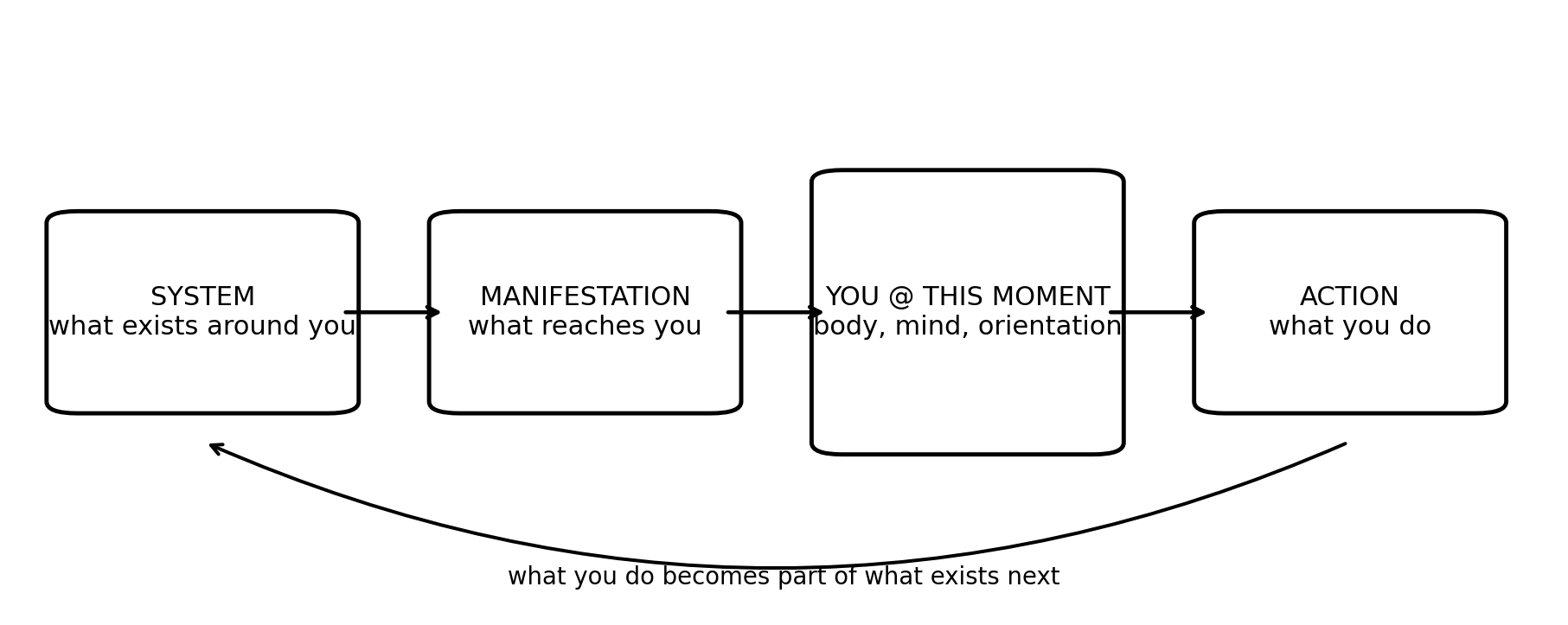
Figure 1. The basic participation loop: what exists, what reaches you, what you do, and what becomes part of the next situation.
CHAPTER 1
Somewhere, Now
The Matrix begins with a claim so simple that it is easy to miss: no human being participates from everywhere at once.
You always participate from somewhere. There is a body, a place, a history, an angle of attention, a set of relationships, a language, a current emotional and physiological condition, and a particular time. You may imagine the whole world, but the imagining still occurs from here.
This is not a defect that must be cured. It is the basic condition of finite life. A person can become wiser, learn more, listen to more perspectives, use instruments, read history, build models, and communicate across the planet. Yet every act of knowing and acting still occurs from a local standpoint.
The Matrix uses the expression Subject-at-Moment to keep this visible. The Subject is not the whole world. The Moment is not the whole history of the world. It is the present intersection at which this particular person is participating.
YOU @ THIS MOMENT
That small phrase does a surprising amount of work. It prevents us from quietly pretending that our present perspective is the perspective of Reality itself. It also prevents the opposite mistake: because our perspective is partial, it does not follow that our participation is unreal or meaningless.
You may not know the whole situation. You can still hurt someone. You may misunderstand another person. You can still apologize. You may not control a System. You can still change one part of it. Finitude limits participation without erasing it.
| The first tension Partial does not mean fake. Local does not mean insignificant. A finite person can participate really in a Reality that exceeds them. |
|---|
This is one of the deepest intuitions of the framework: the human condition is neither omniscience nor helplessness. We are neither outside Reality looking down on it nor meaningless dust with no effect. We are inside it, locally, participating.
| If you remember only one thing You are never the whole picture, but you are really in the picture. |
|---|
CHAPTER 2
The System
The System is the structured world you inherit and participate within - not merely a machine, institution, or government.
When this book says The System, it means the organized field of conditions, objects, people, practices, rules, technologies, environments, symbols, habits, institutions, and relationships within which participation occurs. The System can be scoped narrowly or broadly depending on the question.
At the gym, the relevant System might include the room, equipment, music, social norms, other people, your membership, the layout, your training history, and the informal culture of the place. In a family, it may include relationships, routines, money, memories, expectations, physical space, and patterns of communication. In a city, the System becomes larger again.
There is no requirement that The System be centrally designed. Much of it is inherited. A hallway exists because someone built it. A social expectation may exist because people repeated it for decades. A joke changes the tone of a group. A written rule outlives the person who wrote it. A scar changes what a body can do. All of these can become conditions for later participation.
The important thing is that the human is physically and historically inside Systemic reality, while the human subjective centre is not identical to the whole System. The world surrounds and constrains us, but the world is not simply inside our heads.
HUMAN IN SYSTEM != SYSTEM IN HUMAN
This distinction lets the Matrix resist two opposite reductions. One reduction says everything important is internal psychology. The other says the person is nothing but an effect of external structures. The Matrix keeps the relationship: the person is formed by Systems and also participates back into them.
The System is also never perfectly represented by any one participant. A school may exist as one institution, while a child, teacher, parent, principal, and custodian each encounter very different slices of it. Their experiences can all be real without any one experience exhausting the System.
| If you remember only one thing The System is the structured field you inherit, encounter, and help modify. It is larger than your experience of it. |
|---|
CHAPTER 3
What Reaches You
Something can exist without being available to you, and something can reach you without you understanding it correctly.
Suppose two people are in the same room. A quiet sentence is spoken across the room. One hears it. The other does not. The sentence existed in the shared situation, but it did not manifest equally to both people.
The Matrix calls this participant-relative manifestation: the way some part of Systemic reality becomes available to a particular person. This is broader than conscious thought. Light reaches the eyes. A smell changes the body before you name it. A person enters the room. A notification appears. A facial expression becomes visible. A rule becomes relevant because you encounter the sign that states it.
WHAT EXISTS -> WHAT REACHES ME
This distinction matters because people often argue as if they began with the same informational world. They did not necessarily receive the same evidence, cues, opportunities, instructions, or social signals. Different manifestation histories can produce different beliefs without either person beginning from simple stupidity or bad faith.
Manifestation is not yet interpretation. If someone looks away from you, the look-away can be available to you. Your thought - "they are annoyed with me" - is another layer. The first is something that reached you. The second is what you made of it.
| A tiny Matrix distinction with large consequences Observed: she stopped replying. Interpretation: she hates me. Those are not the same statement. |
|---|
The Matrix does not claim that we can always cleanly separate raw observation from interpretation. Human perception is shaped by expectation, attention, learning, and context. The point is not to build an impossible purity. The point is to preserve a useful difference whenever collapsing the two would hide something consequential.
This is the beginning of the Matrix method: differentiate where the difference matters; collapse the distinction when it earns no useful work.
| If you remember only one thing Reality, what reaches you, and what you think it means are related - but they are not automatically identical. |
|---|
CHAPTER 4
Subject and Moment
The Moment is not a magical slice of time. It is the local site at which a finite Subject participates.
We often speak as if the present Moment is everything: "be in the moment," "live in the now," "this moment is all there is." The Matrix uses Moment more carefully. The present matters because action occurs locally, but the Moment is full of past and future.
Your body carries prior sleep, food, injury, training, hormones, illness, and habit. Your mind carries memory, language, expectation, and unfinished problems. The room carries architecture and history. The person in front of you carries a life you cannot see. The future appears through anticipation and possibility.
So the Moment is better understood as an intersection: past conditions become presently operative; future possibilities become presently imaginable or available; and the Subject participates at that crossing.
| A temporal picture Past is present through traces. Future is present through possibility. Action happens locally in the present. |
|---|
This is why two outwardly identical Moments may not be existentially identical. Two people can stand in the same place doing the same thing while inhabiting very different participant configurations. Even the same person can return to the same room one year later and encounter a different world because they have changed.
The Subject is therefore not a floating point detached from time. Nor is the Subject simply the sum of present stimuli. The Subject arrives already formed, meets what is now available, and becomes different through participation.
| If you remember only one thing The Moment is where inheritance, encounter, possibility, and action meet for a particular Subject. |
|---|
PART II
What Meets in a Human
The Matrix does not reduce a person to four boxes. It asks whether four broad coordinates help us notice what is jointly shaping participation.
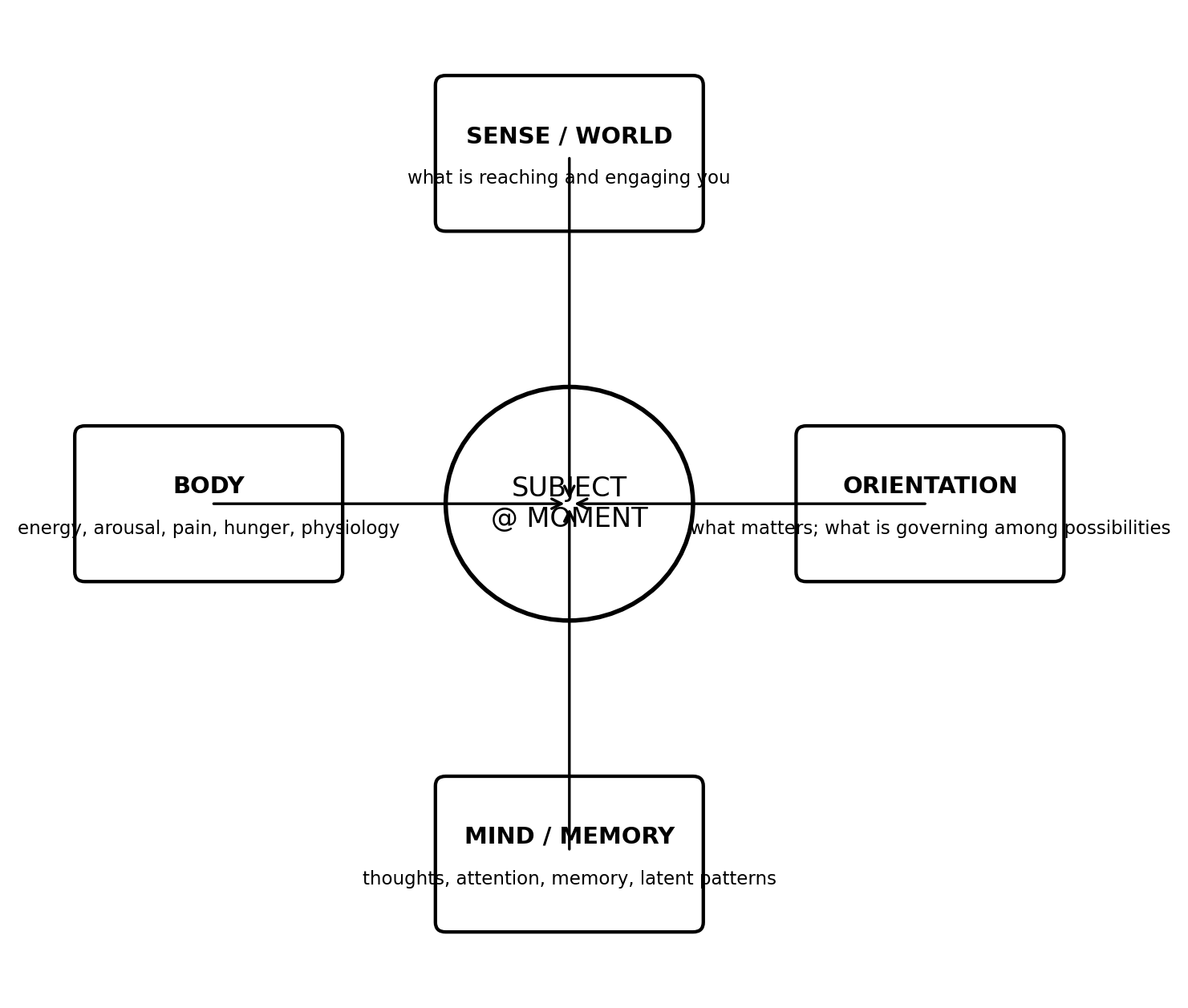
Figure 2. The Four Affections as functional coordinates around a participant, not four separate substances or brain modules.
CHAPTER 5
The Four Affections
A person in a Moment is not just a thought. Participation is jointly shaped by world-engagement, body, cognitive life, and orientation.
The framework currently uses four broad coordinates called the Four Affections. The name is historical. "Affection" here means a way the participant is being affected or configured, not simply an emotion.
The first is Sense / World Engagement. What is reaching you? What are you attending to? What are you doing through your senses and movements? A person cannot be understood apart from ongoing contact with an environment.
The second is Body. Hunger, fatigue, pain, blood sugar, arousal, tension, illness, exercise, sleep, and countless physiological conditions alter what becomes easy, difficult, salient, or threatening. The body is not a vehicle carrying the "real" mind. It is part of the participant condition.
The third is Mind / Memory. This includes current thoughts, attention, beliefs, images, memory, habits of interpretation, and latent material that may become active. The historical term RAM was useful for the sense of "what is currently loaded," but the coordinate is broader than computer working memory.
The fourth is Orientation. This asks a different question: among all the things that could matter, what is presently governing? What has priority? What is this person serving, protecting, pursuing, refusing, or treating as ultimate? The earlier project called this the God Place because every person seemed to have some higher-order orientational role, whether or not they believed in God. The neutral term Orientation is safer for the core framework.
PARTICIPANT CONFIGURATION ~= WORLD + BODY + MIND/MEMORY + ORIENTATION
These are not four independent machines. They overlap and influence one another. A frightening thought changes the body. A hungry body changes attention. A value commitment changes what information is sought. A social encounter changes memory and orientation. The Four Affections are coordinates for inquiry, not claims that nature comes pre-divided into four clean biological modules.
The framework should also remain willing to fail here. Emotion, sociality, agency, or some other coordinate may eventually deserve equal status. The fourfold structure is a candidate map, not sacred furniture.
| If you remember only one thing The Four Affections are a way to ask what is shaping participation without pretending a person is only a mind. |
|---|
CHAPTER 6
Representation Is Not Reality
The Matrix makes a simple distinction that becomes radical when applied consistently: your picture of something is not automatically the thing itself.
You can have a representation of another person, a representation of your body, a representation of your future, a representation of God, a representation of yourself, a representation of what happened yesterday. These representations may be accurate, useful, distorted, incomplete, emotionally charged, or radically wrong.
THING != MY REPRESENTATION OF THE THING
This does not mean representations are useless. Human life depends on them. We remember, plan, imagine, reason, tell stories, use maps, make diagnoses, and interpret other people. The point is not to escape representation. The point is to avoid quietly collapsing representation into Reality.
The distinction is especially important interpersonally. The person in front of you exceeds your model of them. You may know them for twenty years and still not possess them as an object inside your mind. They remain another centre of experience whose full interior is unavailable to you.
The Matrix also rejects the idea that every human interaction with reality must pass through an explicit mental representation. You can catch a ball, recoil from heat, walk through a doorway, or respond to another body in ways that are direct, embodied, and only minimally conceptual. Access is not always the same as representation.
| A correction to an overly mental Matrix Finite access does not imply that humans live inside a sealed mental movie. Reality can constrain and guide us directly through embodied interaction as well as through explicit thought. |
|---|
When representation does matter, however, it becomes crucial to distinguish occurrence, seeming, belief, warrant, and truth. Feeling certain does not make a belief true. A powerful experience can deserve investigation without automatically proving the metaphysical interpretation attached to it.
| If you remember only one thing Use representations. Correct representations. Never confuse possession of a model with possession of Reality. |
|---|
CHAPTER 7
Possibility and the Action Horizon
What you can actually do and what you think you can do are often different sets.
Imagine a person who believes there is no way out of a situation. There may literally be no available route, or there may be routes the person cannot presently see. Those are different problems and they require different interventions.
The Matrix calls the set of actually feasible actions the real Action Horizon. The set of possibilities represented by the participant is the represented Action Horizon.
REAL OPTIONS != OPTIONS I CAN CURRENTLY SEE
Sometimes the real horizon is narrower than imagination: I think I can afford something that I cannot. I think someone will agree when they will not. I think my body can perform an action it presently cannot perform.
Sometimes the represented horizon is narrower than reality: I do not know help is available. I cannot imagine apologizing. I assume a career path is closed. I have never learned the skill that would let me perceive an affordance already present in the environment.
This distinction prevents us from giving the wrong kind of help. If the constraint is structural, encouragement alone may be insulting. If the opportunity is real but invisible, changing the structure may be unnecessary; information, demonstration, confidence, or perspective may be enough.
| Three different constraints Structural problem: the door is locked. Representational problem: the door is unlocked, but I believe it is locked. Orientational problem: I know the door is open, but I am committed to staying. |
|---|
The Action Horizon also makes freedom more concrete. Freedom is not simply an abstract metaphysical quantity. In ordinary life, it often appears as a changing field of available actions, perceived actions, capacities, permissions, relationships, and priorities.
| If you remember only one thing Before telling someone what they should do, ask whether the action is actually available - and whether they can presently see it. |
|---|
CHAPTER 8
Reflection and Participation
Human beings can step back from life, represent it, discuss it, and model it. That power can illuminate participation - or replace it.
There is a Fine Line between seeing life and living it. You can understand that you should listen to someone and still fail to listen. You can write beautifully about love while treating the person in front of you poorly. You can analyze the correct action until the Moment in which action was possible has passed.
UNDERSTANDING PARTICIPATION != PARTICIPATING
Reflection is not the enemy. It is one of the ways humans become capable of correction. We can notice a pattern, reconsider an interpretation, imagine another possibility, examine our values, and interrupt habit. Reflection can make later participation wiser.
The danger comes when reflection becomes self-sealing. The person keeps moving upward into representations of representations: thinking about thinking about what it would mean to act. The map becomes emotionally safer than the territory.
A healthy loop is more like: experience, reflection, discernment, action, new experience. Reflection returns the participant to Reality with changed capacity.
EXPERIENCE -> REFLECTION -> DISCERNMENT -> ACTION -> EXPERIENCE
This is also why the Matrix must contain a warning against itself. The framework can help name distinctions, but naming is not enactment. If studying the Matrix makes a person less available to the person standing in front of them, the framework is failing in that Moment.
| If you remember only one thing Reflection should serve participation. When it substitutes for participation, a useful map has become a hiding place. |
|---|
PART III
Action, Time, and Becoming
Participation is not merely a response to what already exists. What we do becomes part of the conditions that later people inherit.
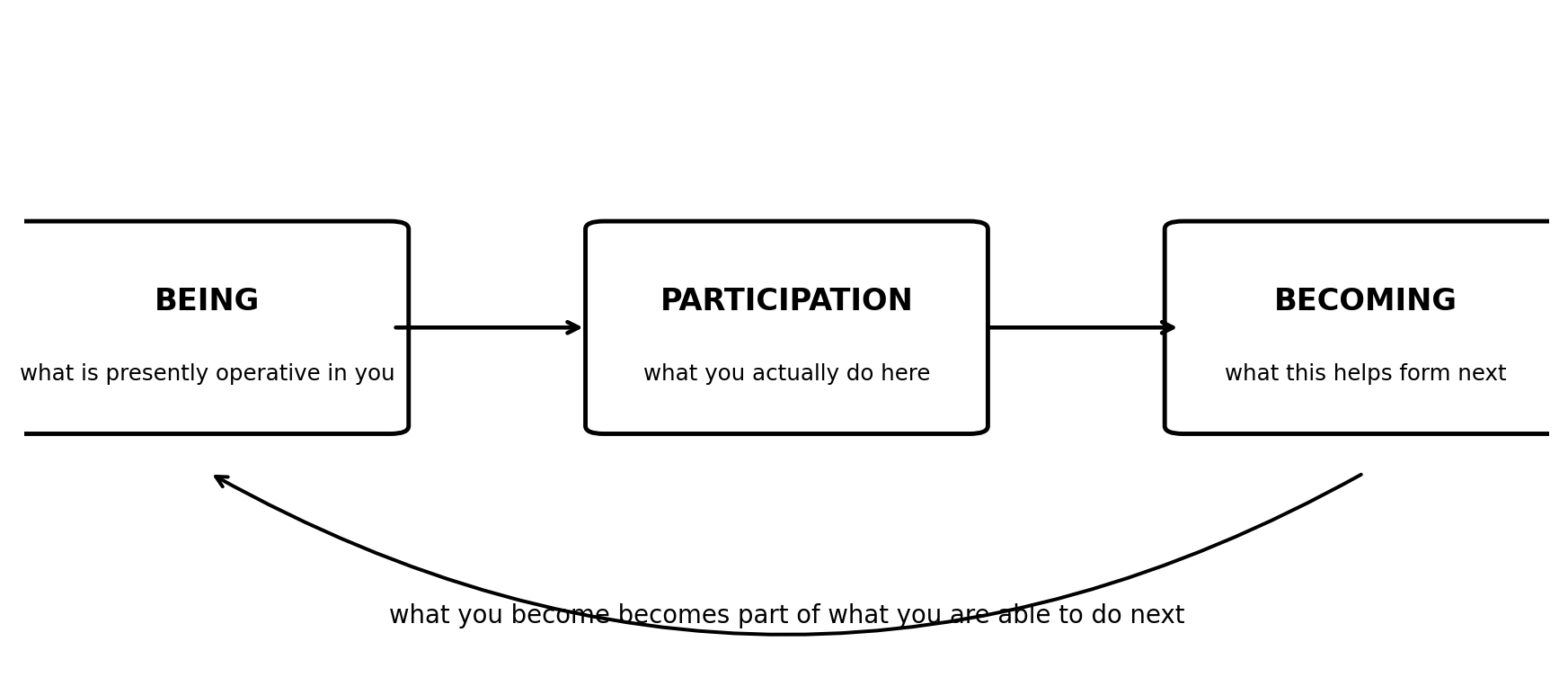
Figure 3. Being, participation, and becoming form a loop across time.
CHAPTER 9
Action Changes the Field
The Subject is affected by the System and also participates back into it.
A person enters a room that already has a mood. They speak. The mood changes. Someone else reacts. A relationship shifts. A sentence becomes memorable. A decision gets recorded. The next person does not enter the same room, even if the furniture has not moved.
The Matrix treats action as real Systemic participation. This does not require grand historical influence. Most action changes only a small local field. But local is enough. A greeting changes an encounter. A neglected task changes someone else's workload. A repair changes what can be done tomorrow. A message changes a relationship.
SYSTEM -> PARTICIPANT -> ACTION -> SYSTEM-NEXT
The loop is not symmetrical. A large institution may shape an individual far more strongly than the individual can shape the institution. A parent has powers a child does not. A law constrains millions of people. A person with money, authority, skill, or social reach may have more capacity to alter later conditions.
This is why agency should not be confused with sovereignty. Meaningful participation does not require total control. A person can have responsibility over a small part of a situation without being responsible for the entire situation.
| A useful middle position Finite responsibility without total sovereignty: I am answerable for participation that is genuinely mine, but I do not control the whole field in which it occurs. |
|---|
This also prevents moral and psychological overreach. We should not attribute every outcome to the individual if structural conditions dominated it. Nor should we erase individual participation simply because structures exist. The Matrix keeps both arrows visible.
| If you remember only one thing You inherit conditions you did not choose, and your participation can become part of what someone else inherits. |
|---|
CHAPTER 10
Positing: When Something Takes Form
Some actions do more than pass through a Moment. They leave behind structures that persist, become accessible, or change relational reach.
The early Matrix used the word Expose for something posited or expressed into the System. The concept is easier to understand through examples.
An unspoken intention becomes a written promise. A private idea becomes a drawing. A conversation becomes a policy. A routine becomes a habit. A repeated informal practice becomes "how we do things here." A memory becomes a story told to the next generation.
In each case, something becomes more stable, available, or capable of affecting people who were not present at the original Moment. The Matrix calls that kind of externalization or stabilization positing.
PRIVATE / LOCAL -> POSITED FORM -> FUTURE AVAILABILITY
The distinction matters because a thought and a written rule do not have the same Systemic life. A thought can disappear with the thinker. A document can be copied, enforced, misunderstood, repaired, and encountered decades later. Once posited, a structure can partly escape the intention that created it.
This is one reason technology matters so much. Writing, databases, architecture, software, institutions, recordings, and networks extend the persistence and relational reach of human action. They let one Moment enter many later Moments.
But positing is not automatically good. A lie can be stabilized. A cruel norm can become an institution. A helpful practice can fossilize after the context that made it helpful has disappeared. Persistence increases consequence, not moral worth.
| If you remember only one thing When participation becomes posited into durable form, it can outlive the participant and shape people who never encountered the original act. |
|---|
CHAPTER 11
Sedimentation and Inheritance
The past does not remain present as the past. It remains present through traces.
A past Moment is gone. Yet its effects can remain in bodies, habits, buildings, records, expectations, relationships, money, laws, language, trauma, trust, skill, scars, and stories. The Matrix uses sedimentation as a name for these persistence relations.
Sedimentation is not a mysterious substance. It is a way of noticing that participation accumulates unevenly. Some actions vanish quickly. Others become conditions for years. Some are intentionally preserved. Others persist accidentally.
PAST ACTION -> TRACE / STRUCTURE -> PRESENT CONDITION
Inheritance then means that a present participant begins inside a field partly formed by earlier participation. You inherit a language before you can choose one. You inherit a body with a history. You inherit technologies you did not invent, conflicts you did not start, opportunities you did not create, and relationships already in motion.
The loop continues because present participation becomes future inheritance. This is true at the scale of one habit and at the scale of civilization.
| The recursive pattern Inherit -> Encounter -> Participate -> Sediment -> Inherit anew |
|---|
This way of seeing time can soften two simplistic stories. One says, "I made myself." The other says, "I am only what happened to me." The Matrix instead depicts a recursive being who is formed by inheritance and also contributes to later formation.
| If you remember only one thing You begin inside a world already formed, and what you do becomes part of the world that comes after you. |
|---|
CHAPTER 12
Being, Participation, Becoming
The moral and existential power of the Matrix becomes clearest when we stop asking only what an action does and also ask what repeated participation forms.
At a Moment, there is a present configuration: body, attention, habits, orientation, relationships, skills, wounds, and possibilities. Call this being - not as a complete metaphysical definition of a person, but as what is presently operative.
Then there is participation: what the person actually does with the Moment they have inherited.
And then there is becoming: the changes in the participant and shared System that follow from participation.
BEING(t) -> PARTICIPATION(t) -> BECOMING(t+1)
Repeated participation can alter later capacity. Practicing an instrument changes the body and nervous system. Repeated avoidance can make avoidance easier. Repeated honesty can shape relationships in which honesty becomes safer. Repeated anger can sediment a pattern other people learn to anticipate.
This does not mean every act permanently rewrites a person. Human systems are noisy, multiscale, and full of repair. But the general recursive point remains: what we do is one of the things from which future doing becomes possible.
This is why becoming is more interesting than moral bookkeeping. A rule asks, "Was this act allowed?" A formation question asks, "What kind of participant does this pattern make me more capable of being? What kind of shared world does it help construct?"
| Two directions of formation An action has at least two futures: what it changes outside you, and what repeatedly acting this way may make easier inside you. |
|---|
| If you remember only one thing You are not only expressing what you already are. Through participation, you are partly forming what you will be able to become. |
|---|
PART IV
Distinctions and Fine Lines
The Matrix repeatedly makes the same move: distinguish things that matter without pretending the distinction exhausts Reality.
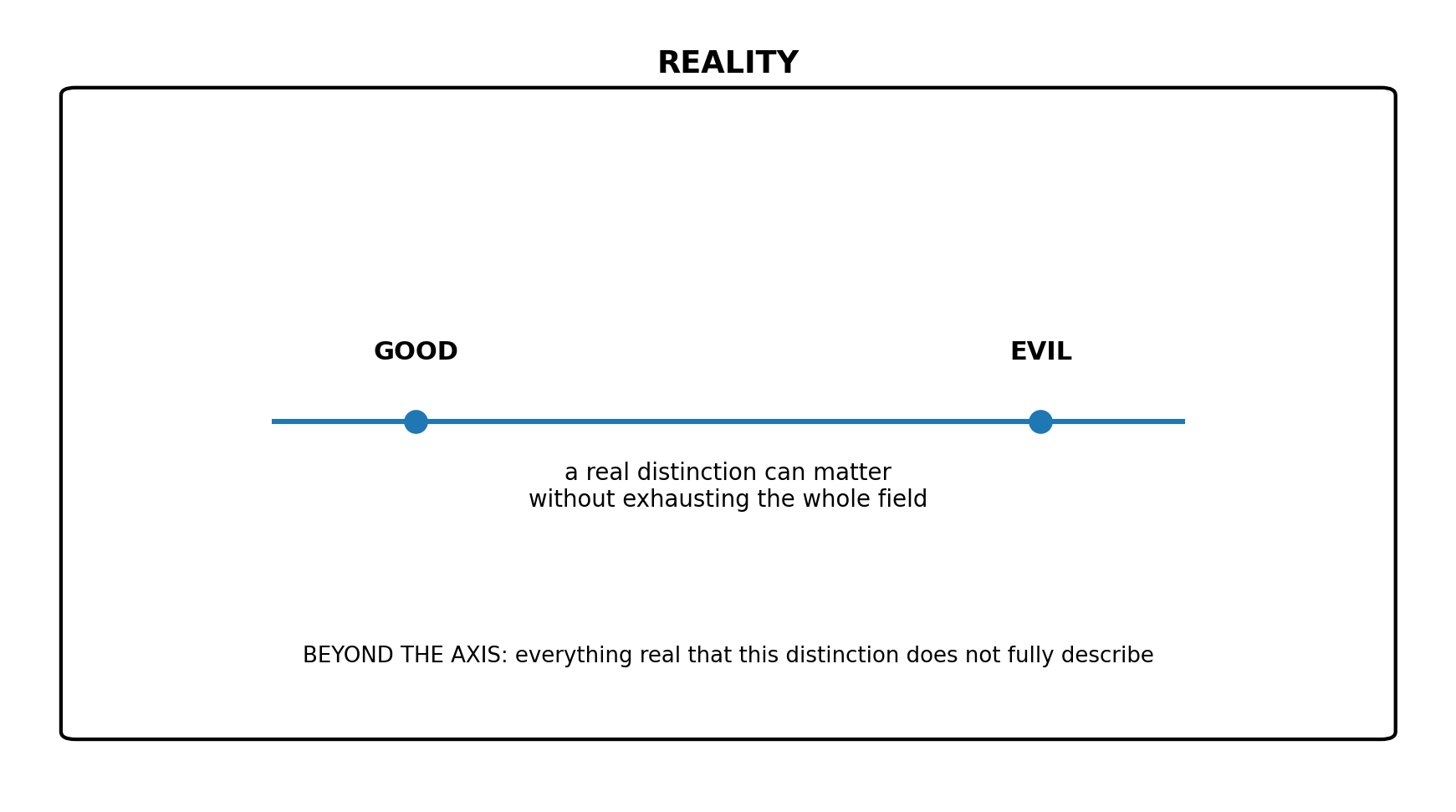
Figure 4. A distinction can be real and morally important without exhausting the larger field of Reality.
CHAPTER 13
Dichometries: Real Distinctions, Larger Reality
A distinction can be true without being complete.
Human beings organize experience through contrasts: true and false, safe and dangerous, self and other, inside and outside, beautiful and ugly, loyal and disloyal, good and evil. The Matrix calls a structured contrast of this kind a Dichometry.
A Dichometry does not have to be a crude binary. There may be gradients, mixed cases, context, uncertainty, thresholds, and multiple dimensions. The point is that something is being understood relative to a contrastive field.
The important insight is that seeing beyond a distinction does not automatically make the distinction false. If good and evil are real, Reality may still contain countless truths that are not exhausted by classifying them as good or evil. A tree can be involved in moral action without the whole reality of the tree being a moral category.
REAL DISTINCTION != EXHAUSTIVE DESCRIPTION OF REALITY
This protects two truths at once. First, categories can matter. Calling cruelty cruelty is not necessarily a failure of nuance. Second, the person, event, object, or Reality being classified can exceed the category.
This is also a defense against a common intellectual mistake: when we discover that a category is partial, we sometimes jump to the conclusion that the category is unreal. The Matrix instead asks whether the distinction earns its work in this context.
| If you remember only one thing You can enter a distinction without becoming imprisoned by it. |
|---|
CHAPTER 14
Fine Lines
A Fine Line is not necessarily a midpoint. It is a consequential transition whose location depends on what is being measured, decided, or valued.
People often say there is a fine line between confidence and arrogance, patience and passivity, reflection and avoidance, discipline and obsession, forgiveness and enabling, openness and lack of boundaries. The phrase is useful because it recognizes continuity and difference at the same time.
The Matrix separates at least three kinds of Fine Line. A functional line is where a process begins behaving differently. A decision line is where a participant chooses to classify or act differently. A normative line is where a moral or evaluative criterion changes what ought to be done.
FUNCTIONAL LINE != DECISION LINE != MORAL LINE
These may coincide, but they do not have to. A medical measurement can cross a functional threshold before a person notices. A legal threshold can be set for practical reasons rather than because nature itself contains a sharp boundary at exactly that number. A moral threshold may depend on intention, capacity, relationship, and context.
The phrase Fine Line is therefore not an excuse to make everything vague. It is an invitation to ask: what changes across this boundary, according to which criterion, and for whom?
One of the most important Fine Lines in this book is reflection versus participation. Another is understanding a person versus reducing them to your understanding. Another is having a real moral distinction versus believing that distinction exhausts the Reality being judged.
| If you remember only one thing A Fine Line becomes useful when you can say what changes across it and why the change matters. |
|---|
CHAPTER 15
The Other Exceeds Your Picture
Another person is not your representation of them.
This may be the simplest interpersonal consequence of the Matrix and one of the hardest to live consistently. Every person you encounter reaches you through manifestations: words, expressions, actions, history, reputation, messages, body language, shared events. From these you form a representation.
That representation can become very good. It can never become the other Subject in full.
OTHER PERSON != MY MODEL OF THE OTHER PERSON
Empathy does not erase this gap. In fact, mature empathy may depend on respecting it. To empathize is not to declare, "I know exactly what you feel." It is to let what reaches you from another person alter your own configuration while remaining aware that your response is still yours.
This gives us a useful separation between resonance and accuracy. You can be deeply moved by someone and misunderstand them. You can understand their state accurately while feeling very little of it yourself. Feeling understood, actually being understood, agreeing, and being loved are not the same thing.
| Empathy is not one thing High resonance + low accuracy is possible. Low resonance + high accuracy is possible. Agreement is another variable again. |
|---|
This distinction also changes conflict. If the other person exceeds my representation, correction remains possible. I can approach a disagreement with strong conviction without needing to pretend that my model of the other person is complete.
| If you remember only one thing Love, empathy, and understanding become safer when the Other is allowed to remain larger than your picture of them. |
|---|
CHAPTER 16
Disagreement Has a Shape
Two people can say the same opposite words for completely different reasons.
Imagine two people disagree about a decision. We often respond by throwing more facts at the problem. But facts are only one place disagreement can occur.
They may have encountered different information. They may interpret the same information differently. They may trust different methods or sources. They may frame the problem differently. They may agree on facts but use different thresholds for action. They may share the threshold but prioritize different goods.
The Matrix calls this the shape of disagreement. Instead of asking only, "Who is right?" we first ask, "Where is the divergence actually located?"
Access: did the same relevant information reach both people?
Representation: do they believe different things about what happened?
Epistemic standards: do they disagree about what counts as evidence or a trustworthy method?
Frame: are they answering different versions of the problem?
Placement: do they locate the case differently on a shared dimension?
Threshold: do they use different criteria for when action should change?
Orientation: do they ultimately prioritize different goods, values, or loyalties?
This matters because intervention should match problem level. If one person never received the evidence, equalize access. If both have the evidence but disagree about standards, sending the same evidence again may accomplish nothing. If the disagreement is moral, pretending it is merely factual can make both people feel unseen.
| A different target Better disagreement does not always mean agreement. It can mean that the remaining difference is accurately located and mutually understood. |
|---|
| If you remember only one thing Before trying to solve a disagreement, locate the level at which the disagreement actually lives. |
|---|
PART V
What the Matrix Is For
A framework earns its keep by revealing consequential structure, not by giving everything a new name.
CHAPTER 17
A Descriptive Framework and Its Moral Edge
The Matrix can help describe what is, what is available, what is represented, and what participation tends to form. It cannot manufacture an ultimate Good from description alone.
Suppose the Matrix perfectly described a Moment: every relevant condition, every available action, every belief, every likely consequence. We would still need a criterion for deciding which consequence should be preferred. Understanding structure does not automatically create moral authority.
DESCRIPTION + NORMATIVE GROUND -> PRESCRIPTION
This is important because an intelligent manipulator could use accurate Matrix knowledge to manipulate more effectively. Better understanding does not guarantee better morality.
Still, the Matrix gives morality somewhere concrete to operate. Once a moral standard is supplied, the framework can ask whether an action responds to reality truthfully, recognizes the Other as more than an instrument, uses available capacity responsibly, and contributes to forms of self and System that make future good participation more possible.
A neutral moral extension might call this right participation. It would not pretend to prove the ultimate ground of goodness. It would ask a practical question: given what is actually true and possible here, what participation best serves the genuine good rather than merely immediate desire?
| A possible moral grammar - not a proof of morality See truthfully. Regard rightly. Act responsibly. Notice what your action forms. |
|---|
Different traditions will answer the grounding question differently. Some will ground the Good in God, some in flourishing, rationality, personhood, compassion, or moral realism. The core Matrix can remain open at that level while still showing where normative premises enter.
| If you remember only one thing The Matrix can clarify moral discernment, but it should not pretend that a diagram has generated the Good. |
|---|
CHAPTER 18
Using the Matrix Without Becoming Trapped in It
If everything can be translated into Matrix language, the framework risks becoming useless.
A sandwich can be described as a Systemic object that manifests to a Subject at a Moment and affects the body. That is true enough. It is also probably pointless. A framework becomes empty when merely renaming something counts as explaining it.
So the Matrix needs a relevance test. Use the framework when it does at least one of the following: reveals a distinction that was hidden, changes a diagnosis, changes an intervention, generates a testable prediction, exposes a meaningful Fine Line, or shows that a part of the framework itself should be revised.
Did the Matrix reveal a consequential distinction?
Did it explain a relationship that was previously confusing?
Did it change what action or intervention would make sense?
Did it generate a prediction that could be wrong?
Did it reveal that two concepts should actually be collapsed?
Did it reveal a missing dimension or failure in the framework?
If the answer is no, the intuition may still be interesting. It simply does not need to become a new Matrix construct.
The same discipline applies to the Four Affections, Fine Lines, Action Horizons, and every other term in this book. Distinctions should earn their complexity. If two variables repeatedly add no different predictive, diagnostic, conceptual, or intervention value, they should be merged.
DIFFERENTIATE -> RELATE -> TEST -> RETAIN OR COLLAPSE
This is the Minimum Sufficient Distinction principle. It is less glamorous than building a total philosophy, but it may be what keeps the Matrix alive rather than turning it into doctrine.
| If you remember only one thing Do not ask, "Can I describe this with the Matrix?" Ask, "Does the Matrix help me see or do something I could not see or do as clearly before?" |
|---|
CHAPTER 19
Where the Matrix Ends
The Matrix is intentionally unfinished because Reality is not obligated to fit the framework.
There are questions the Matrix can organize without answering. What grounds morality? Is there an objective Good? Is God real? Is consciousness reducible to physical process? What is Nothingness? Are there forms or structures that exist independently of human minds? The framework can distinguish claims about these questions, but distinction is not proof.
There are also empirical questions the Matrix must allow researchers to answer against it. Are the Four Affections really a useful minimal decomposition? Does separating manifestation from representation improve prediction? Does the represented Action Horizon measurably dissociate from real opportunity? Does classifying disagreement by level improve interventions? If not, the framework must change.
And there are experiential limits. A person can understand every chapter in this book and still be unkind, frightened, confused, selfish, loving, courageous, exhausted, joyful, or wrong. A map of participation does not become the participant.
| The boundary statement The Matrix is not proposed as a worldview to be inhabited, a comprehensive account of Reality, or a normative system by which a person must live. It is a conceptual instrument for distinguishing aspects of finite participation that may otherwise be confused. |
|---|
The deepest sentence of the Matrix may therefore be its act of self-limitation: Reality exceeds representation. That statement applies to every representation, including this one.
The framework is an attempt to describe some of the structure of human participation - not to replace the Reality in which participation occurs.
MATRIX != REALITY
If this book works, you should be able to close it and see ordinary life with slightly better distinctions. Then the book should disappear into the background. The person in front of you, the room you are standing in, the action actually available, and the becoming that follows are more important than remembering the vocabulary.
| If you remember only one thing Use the map. Return to Reality. |
|---|
APPENDIX A
The Matrix on One Page
A compact version you can hand to someone who wants the whole picture in a few minutes.
1. You are a finite Subject participating locally at a Moment. Your perspective is real but not exhaustive.
2. You participate within a structured System larger than your subjective experience of it.
3. What exists, what becomes available to you, and what you represent are related but not always identical.
4. Your participation is shaped by a changing configuration. The current candidate coordinates are world/sense engagement, body, mind/memory, and higher-order orientation.
5. What you can actually do and what you think you can do can differ. This is the difference between real and represented Action Horizons.
6. You act. Your action can alter both your later configuration and the shared System.
7. Some participation becomes posited into durable form and sediments into conditions later people inherit.
8. Being, participation, and becoming therefore form a recursive loop through time.
9. Distinctions can be real without exhausting Reality. Fine Lines mark consequential transitions under particular criteria.
10. Another person always exceeds your representation of them. Empathy, understanding, agreement, and accuracy should not be collapsed.
11. Disagreement can occur at different levels - access, representation, standards, frame, threshold, or orientation - and interventions should match the level.
12. The Matrix describes structure. It does not create morality by itself. A normative layer must state what should govern participation.
13. The framework itself is corrigible. If a distinction adds no consequential value, collapse it. If a missing distinction matters, add it.
14. The Matrix is not Reality. It is useful only insofar as it helps finite participants return to Reality with better understanding or better possibilities for action.
The one-line picture: System -> manifestation -> participant -> action -> later System.
APPENDIX B
Plain-Language Glossary
| Term | Plain-language meaning |
|---|---|
| Subject | A finite centre of experience and participation - the person as a participant, not the whole biological or metaphysical definition of a human. |
| Moment | The local present intersection at which a Subject participates. It contains traces of the past and possibilities toward the future. |
| System | The structured field of objects, people, rules, environments, practices, technologies, relationships, and conditions relevant to the question. |
| Manifestation | The way some part of Systemic reality becomes available to a particular participant. |
| Representation | A belief, model, image, memory, interpretation, or other participant-side representation of something. |
| Participant Configuration | The changing set of conditions presently shaping participation. |
| Four Affections | The current candidate coordinates: world/sense engagement, body, mind/memory, and higher-order orientation. |
| Orientation | What is governing among possibilities: priorities, commitments, values, loyalties, goals, or what the person treats as ultimately important. |
| Action Horizon | The field of possible actions. The real horizon is what is actually feasible; the represented horizon is what the participant currently sees as possible. |
| Positing / Expose | The externalization or stabilization of something such that its persistence, availability, or relational reach changes. |
| Sedimentation | The persistence of past participation through traces, structures, habits, records, bodies, institutions, and relationships. |
| Dichometry | A structured contrast or dimension used to organize experience, such as safe/dangerous or good/evil. |
| Fine Line | A consequential transition or boundary under a specified functional, decision, or normative criterion. |
| Disagreement Shape | The pattern of levels at which two or more participants diverge: access, representation, epistemic standards, framing, thresholds, orientation, and related factors. |
| Empathetic Resonance | A change in one participant produced through manifestations from another participant. It is not the same as accurate understanding. |
| Minimum Sufficient Distinction | Keep distinctions where collapsing them loses consequential information; merge distinctions that do not earn their complexity. |
The framework ends where participation begins again.
Close the book. Look around.
Something is reaching you.
You are here.
What will you do?